Governed compute for large, valuable datasets.
Private AI, 3D and heavy processing on your nodes, under your policy. The data stays where it should, and the work moves to the machine that is allowed to run it. Already in production in AerariumChain and SweetHive.
Built in Europe. Deployable globally.

3D render output · AerariumChain production pipeline
AI and heavy compute are built for the giants.
Organisations that hold large, valuable datasets have three options today, and none of them fits. Who runs private AI and heavy compute for everyone else?
Rent a hyperscaler
Priced for enterprises.
Pricing is built for large accounts, and the data has to move to someone else's infrastructure before any work can start.
Buy the hardware
Idle most of the month.
GPUs and servers sit unused between peaks, and there is nobody in house to run, update and secure them.
Send the data out
Control is gone.
Once scans, archives or models leave, you no longer decide where they go, and you pay again for every job.
One repeatable pipeline, from local acquisition to tools.
Data stays where it should. Work moves to the machine that is allowed to run it.
-
01
Local acquisition
Where the data is born: scanners, company machines, archives, local models.
-
02
Upload
Only what must move, and only what policy allows.
-
03
Distributed processing
Unattended, on nodes chosen by the router.
-
04
Upload
Validated results, with a record of where they ran.
-
05
Tools
Hubs, viewers, apps and agents, on any device.
Governed end to endPermissionsResidencyCapacityCost
The same five steps run a museum and a small company today.
From your nodes to the network.
One execution continuum governed by the router: work runs on our nodes, on nodes installed on your own hardware, or on idle capacity that customers and partners make available to the network, always under the same policies.
What the router makes possible.
Four capabilities, the same for a museum and for a small company.
Heavy processing at a fraction of the cost
Unattended, on our own and partner nodes, at a fraction of hyperscaler cost. Customers can make their computing capacity available to the network when they do not need it, and unit cost falls as the network grows.

Complex workflows on local nodes
Any processing workflow, even a complex one, is set up quickly on the node network through the job scheduler. For every step, the router picks the machine allowed to run it, checks that its capacity is real, recovers from failures and validates the output.
Local AI, easily managed
Models run on your local nodes and we keep them current. Private agents know only what your teams allow, and nothing leaves without policy.
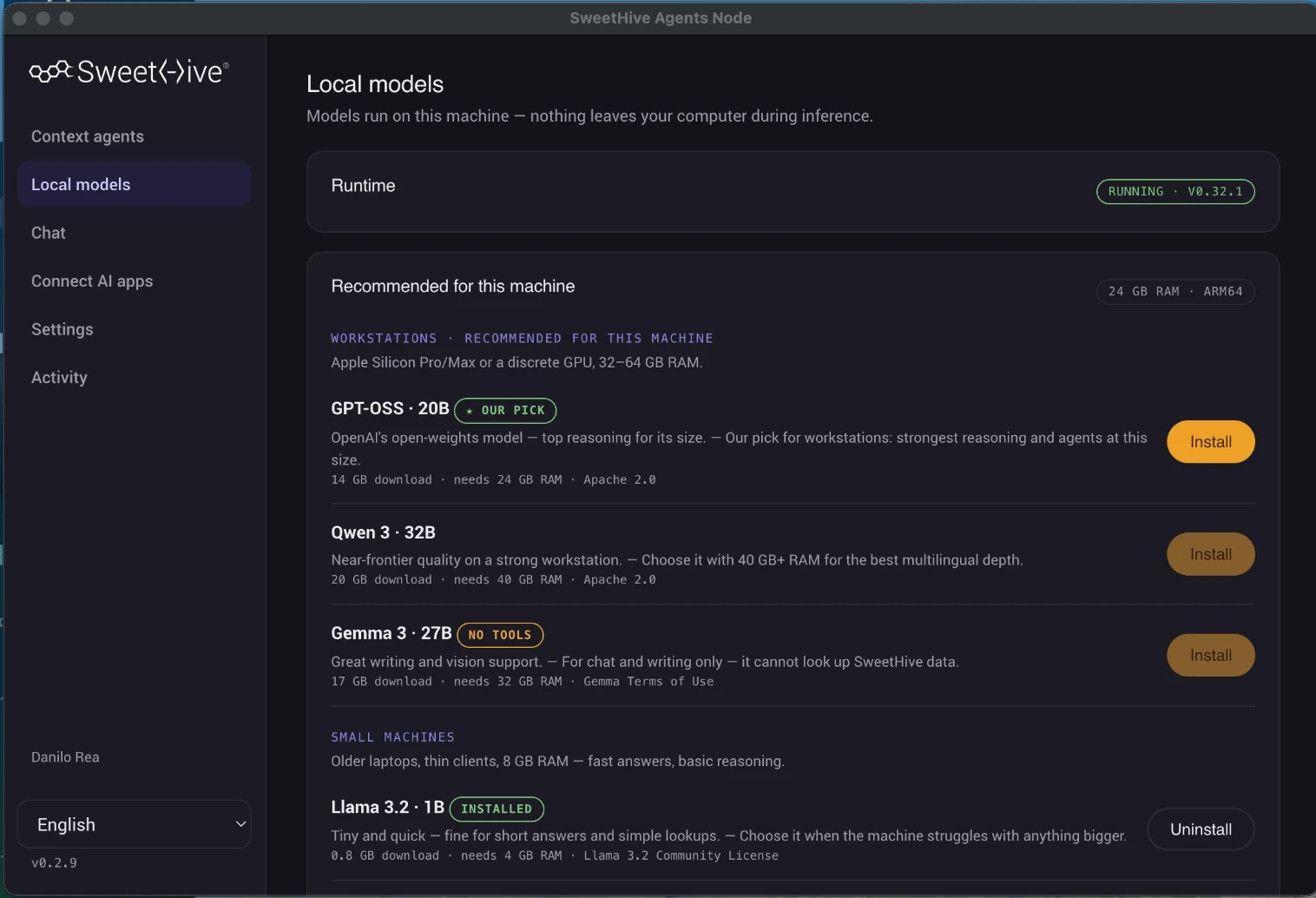
Tools and real-time access on any device
Heavy data streamed from remote nodes to hubs, viewers and apps on any device, without the source data ever being copied to user devices.
Proven where data are hardest.
We did not validate TrustTwin OS in a lab. We validated it in Europe's museums: heavy 3D data, irreplaceable objects, strict rules on where data can go.
An environment where failure is expensive and data cannot simply be moved or recreated. That is why AerariumChain came first. SweetHive now brings the same OS to small and mid-size businesses.
TrustTwin OS Core.
In the coming years the OS itself becomes the product: as white label for partners, or as core infrastructure that enterprises run on their own nodes. Today we are building it with partners and early design partners.
Where the same pattern repeats
Large files, private datasets, partner collaboration, GPU bursts, controlled hosting, audit obligations.




Control is part of the architecture.
Data residency is enforced, not promised. Configure local, private, EU-only or country-specific processing, with EU-only profiles that exclude non-European providers entirely.
Where data lives.
Where workloads execute.
Where inference happens.
If a residency rule cannot be guaranteed, the workload does not run.
Particularly valuable for European deployments. The underlying control model is relevant globally.
One architecture. From private AI to the heaviest digital twins.
For partners, pilots and early design partners: tell us about your data and your workloads, and we will show you how TrustTwin OS runs them on your nodes, under your policy.